Girl Math vs Gold.
Why the real investment was in your jewellery box all along.

When I first heard the term ‘girl math’ I chuckled to myself, assuming it was some maniac’s excuse for buying a ridiculously overpriced fashion piece. A way of convincing ourselves that something expensive, somehow, was worth it. Oh, how naïve of me.
A few weeks later, I had become set maniac.
Soon enough I was fully lured into the world of girl math, my justifications for purchasing an overpriced pair of shoes or bag coming in thick and fast. BUT can we just pause and talk about that fact, Khiate boots are £1,340 and Chanel’s new tote is over £8k and below £45k in croc. Anyways. Back to my rant - obviously I was going to wear it until the end of time. Of course it was a ‘classic’. And no, there definitely wouldn’t be anything else similar any time soon.
Plot twist: there is always something else, and most of the time - it’s pretty soon.
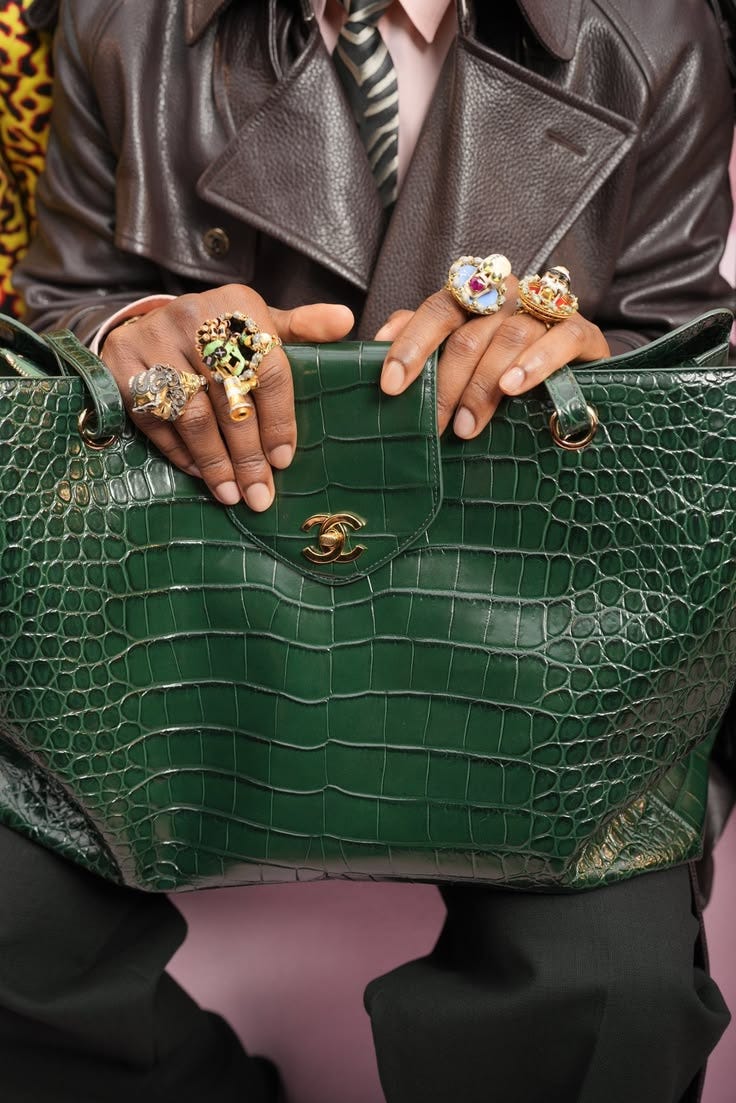
ASAP Rocky, with Green Chancel Croc bag. Rings (- this could be another substack topic), a private collection with the MOST UNREAL jeweller in Venice - A. Codognato.
The phenomenon of how handbags have now become ‘investments’ lies somewhere between girl math and Sotheby’s auctions. We have somehow convinced ourselves that buying a bag is a financial strategy. But this is where I started asking myself: when did a leather accessory become an asset - and how did fine jewellery quietly lose that title?
As someone who works (and loves) in fine jewellery - a world that historically represented one of the oldest forms of personal wealth, I find this particularly interesting. Gold was security. Jewellery was portable value. Yet somewhere along the way handbags and shoes started being touted as investments instead.
And when did fashion purchases start being discussed like financial instruments? And when exactly did a handbag become an asset?
In a world of social media - where your life is ‘apparently’ only being really lived if it’s on Instagram - enter the ultimate status symbol: the Hermès Birkin (or the Mini Kelly). Often perched on a restaurant table next to an oat iced matcha (which I still don’t understand at all - and don’t get me started on these increasingly dessert-like coffees. I blame Blank Street and their bizarre concoctions. Why is a strawberry and cream iced latte a thing at 7.30am? No. It’s also not coffee. Anyway, I digress).
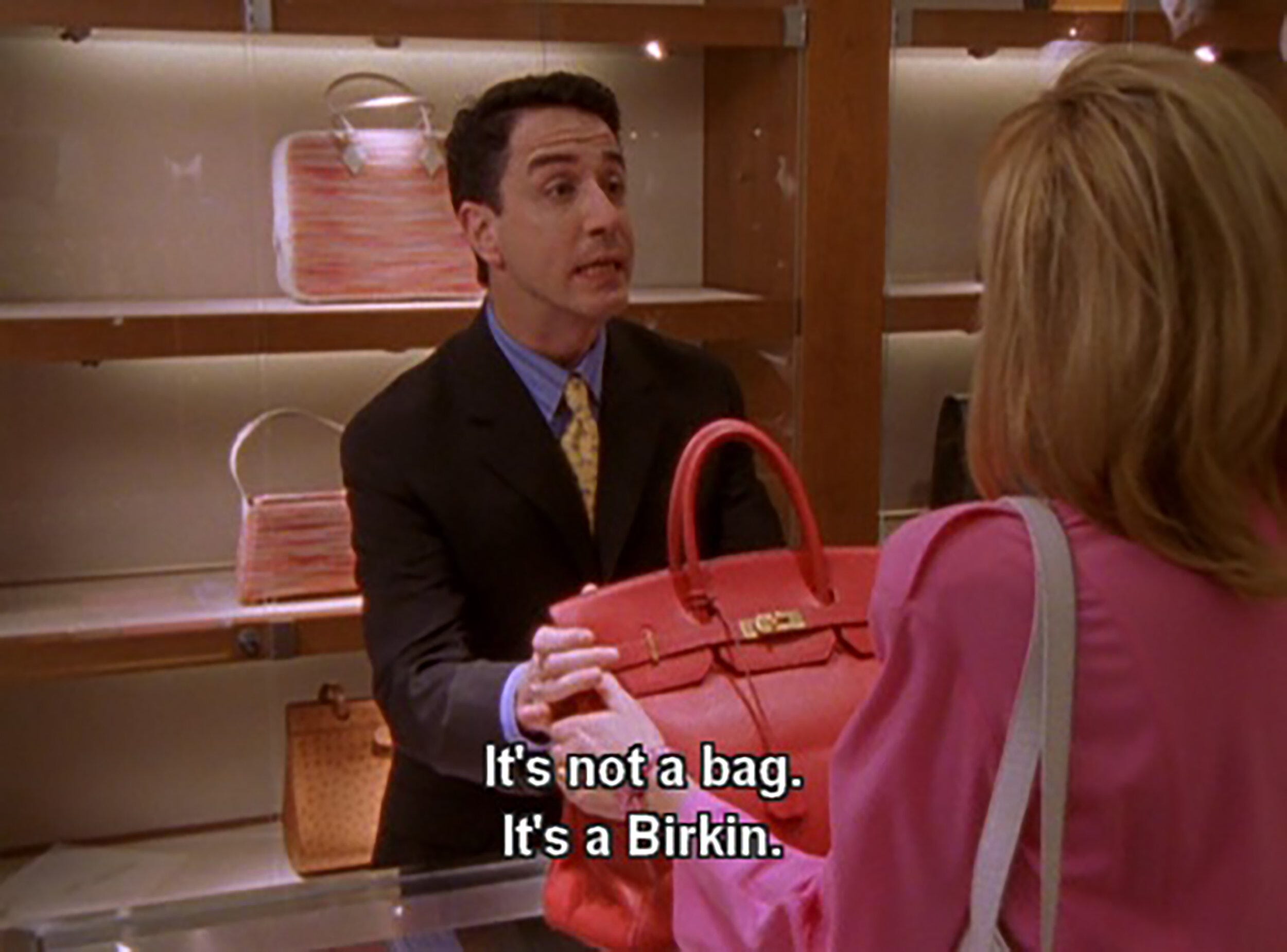
Sex and the City.
Everyone wants a Birkin (or another Hermès tote), and almost no one can get one. Unless you know someone very, very important at the boutique in Paris, or you’ve bought enough Hermès homeware and ready-to-wear to furnish three houses. Or you’re even more crazy than most and pay x10 its value via re-sale.
And don’t get me wrong - Jane Birkin herself was effortlessly cool (the O.G of cool), and her famously battered bag from 1985 was a 10/10. Which btw (and if hadn’t heard and you were living under a rock) sold at sotheby’s in Paris last summer for 8.6 million euro, becoming the most expensive bag ever sold at auction. Insanity. But is it?
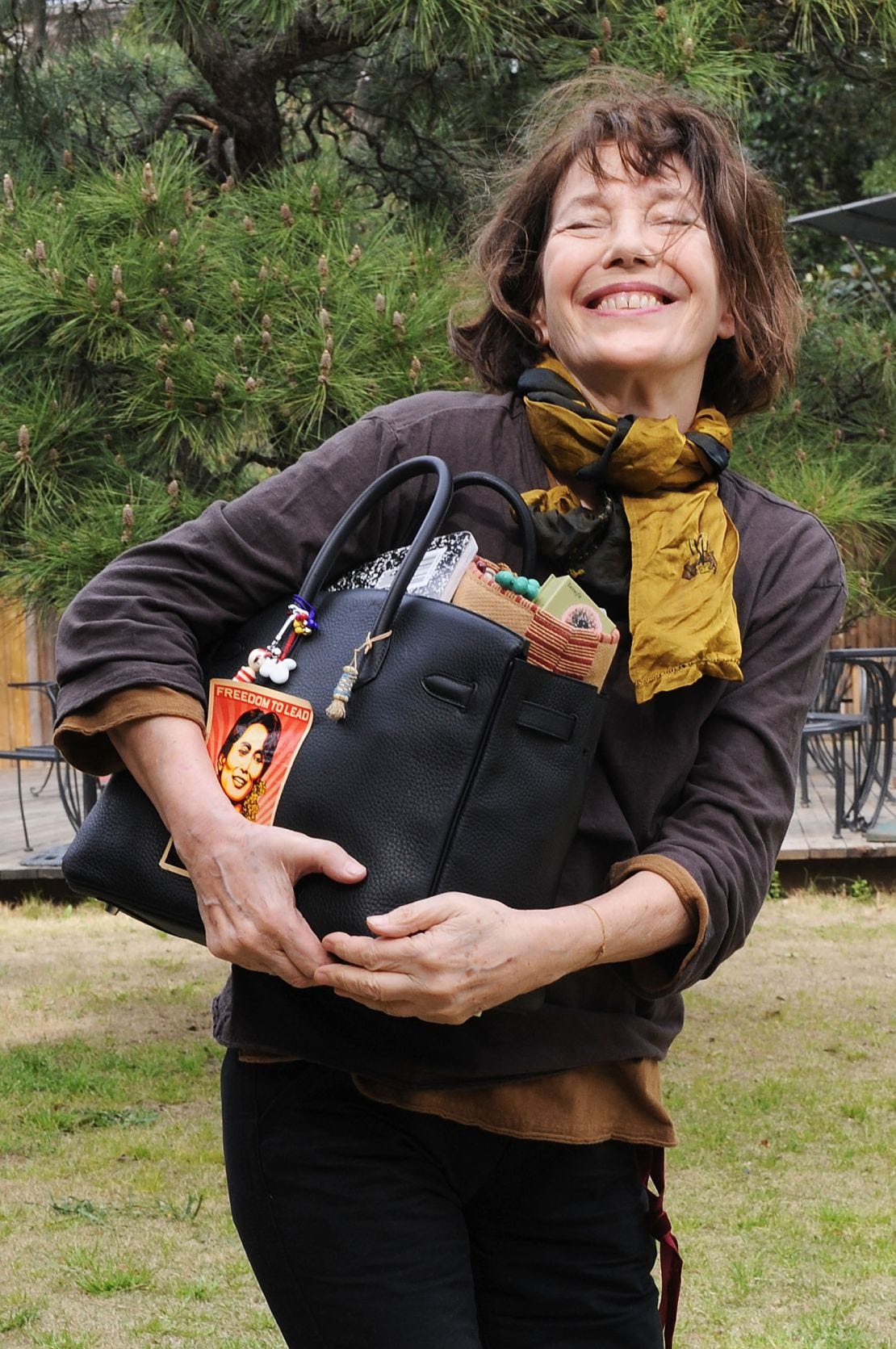
Jane Birkin, with her namesake handbag.
But it does make me wonder: why is this bag more lusted over than a beautiful piece of fine jewellery?
Did handbags actually become investments - or did we simply start calling them that?
Gold doesn’t care if it is trending. And historically, it never needed to be.
Jewellery used to be the real deal investment. And for pretty good reason. It’s difficult to pinpoint exactly when gold was first discovered and used by humans, but one of the earliest and most remarkable discoveries comes from the Varna Necropolis in Bulgaria. Archaeologists uncovered the site near the Black Sea in 1972 and dated it to around 4600 BCE. Inside the burial ground were more than 3,000 gold artefacts, making it the oldest known collection of worked gold in the world.
Curiously, some of the graves weren’t intended for human burial at all. Instead of skeletons, they contained elaborate offerings of gold and other treasures - symbolic burials filled with wealth. It seems early civilisations hadn’t yet adopted the saying: you can’t take it with you - they did.
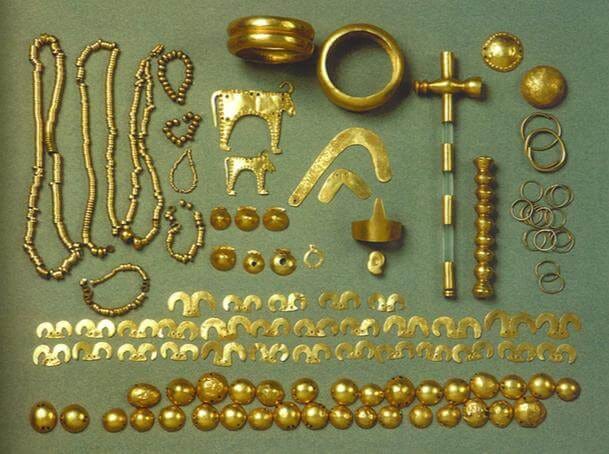
Early gold and jewel treasures from Varna Necropolis.
Gold has fascinated civilisations for thousands of years. The ancient Egyptians, for example, took it rather seriously. When Tutankhamun’s tomb was discovered in 1922, archaeologists found him buried with solid gold slippers - I mean, talk about bouji. I have a lot of time for those sweet little bows too.
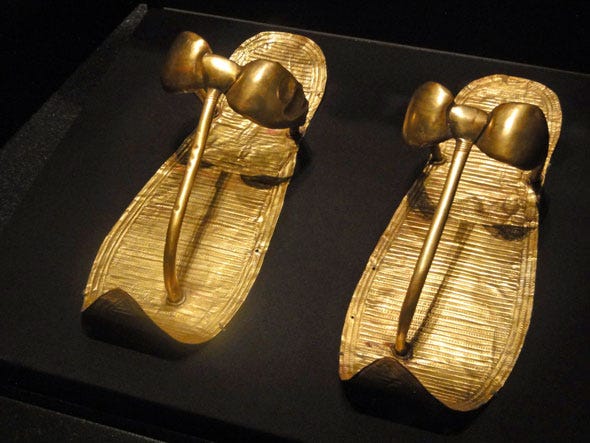
Tutankhamun’s gold slippers.
And of course there was the infamous death mask, weighing just over 10 kilograms of solid gold. At today’s gold price that alone would be worth roughly £1.1 million (give or take, depending on what gold decides to do tomorrow).
Apparently even the afterlife required a strong jewellery collection.
Gold has also always carried this almost mythical quality. Entire civilisations were built around it. Kings were buried in it (see above). And if you grew up watching Aladdin, you probably imagined the Cave of Wonders - mountains of glittering treasure piled impossibly high.
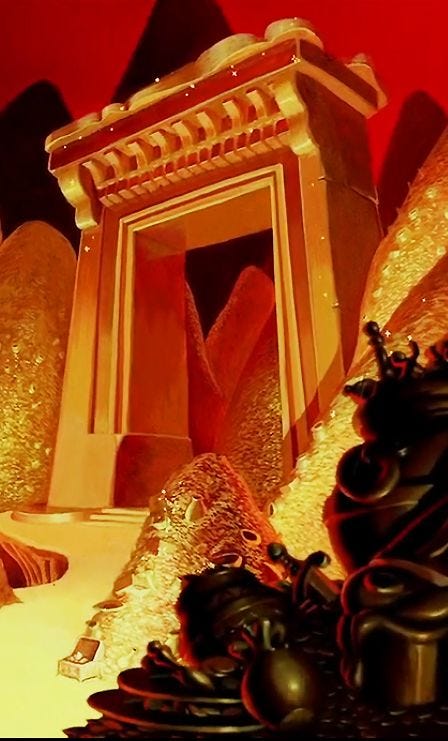
Aladdin and The Cave of Wonders. Disney 1992.
Turns out that image isn’t entirely fantasy. Humans have been hoarding gold for thousands of years.
Historically, gold stored wealth. It is difficult to mine, finite, and remarkably durable - it really does last forever. It wasn’t decoration first, but financial security. Gold could be carried, hidden and traded. Much easier to transport than land or property.
For centuries, jewellery was one of the few forms of wealth women could actually control. From the stacking bangles worn across India, to gold jewellery throughout the Middle East, to European dowries, gold functioned as both adornment and asset.
And what makes gold particularly fascinating is how little of it actually exists. All the gold ever mined in human history would fit into a cube roughly 22 metres by 22 metres by 22 metres - about the height of a five-storey building. That’s it. Every coin, necklace, bar and crown humanity has ever pulled from the earth. Geologists estimate there may be around 50,000 tonnes left to mine, which sounds like a lot, but in global terms it’s not a lot.
As jewellery passes through generations, it accumulates not only financial value but emotional weight too - engagement rings, your granny’s treasured gold earrings, family heirlooms. Jewellery moves through families carrying both material and sentimental value. I’m not entirely sure a Balenciaga Rodeo will do the same, do you?
Fast forward to today, and gold has returned to the conversation - largely because of its volatility. Its price is shaped by economic instability, inflation, geopolitical tension and currency fluctuations, pushing investors toward assets that feel tangible and stable.
Gold has always been considered a safe haven. And in uncertain times, people tend to return to things that are real.
Now, we’re going to dive into the juicy part - the difference between intrinsic value and perceived value.
Gold holds intrinsic value rooted in the material itself - the weight of the gold, the quality of the gemstones, the craftsmanship of the piece. Strip away the brand and any fancy marketing, and it still has value. Gold can be weighed, melted, traded and sold anywhere in the world. Its value exists independently of trends, taste or who happens to be carrying it this season.
I recently visited RPM in Hatton Garden (a superb place to sell gold if you have any spare lying around) and a lady in the next cubicle brought in ceremonial wedding jewellery for a price. I heard ‘130’ and thought, surely not £130,000. But since I’ve got a few pals in there I enquired about the value, yep - it was £130k. I nearly had an actual heart attack.
Handbags on the other hand rely almost entirely on perceived value. Their worth comes from brand, status and cultural relevance. A Birkin is valuable because Hermès has built an entire ecosystem around scarcity and desirability. If the cultural moment shifts - if tastes change, if the brand loses its aura - the value shifts too. Bye, bye little pistachio Mini Kelly with gold hardware.
In other words, jewellery contains value. Handbags perform value.
That doesn’t make one better than the other (ish) - they simply function differently. One is grounded in material reality. The other exists in the realm of fashion, identity and cultural signalling.
And perhaps that’s why the conversation around ‘investment pieces’ has become so muddled. One category was historically designed to hold wealth. The other was designed to express taste.
Both can be beautiful. Only one has gold inside it. What’s the better girl math at this point?
I follow this brilliant jeweller in New York or at least I suppose you could call him that - Moses the Jeweller. I actually stumbled into his store with my cousin on a recent trip and have since been mildly obsessed with his audacity since. With over 2.2 million followers, people clearly enjoy the theatre of it all. He operates somewhere between jeweller, hype man and market commentator. A modern day Pierre Cartier.

Moses.
His most recent stunt was particularly telling. To illustrate just how high the price of gold has climbed, he took an 18-carat yellow gold Audemars Piguet watch and melted it down for scrap proving that the raw gold inside it was worth more than selling the watch itself. WTAF.
Which raises an interesting question: what exactly happened to brand value there?
Because if the metal inside the watch is suddenly worth more than the watch as a luxury object, the hierarchy flips. The craftsmanship, the heritage, the name on the dial - all of it momentarily becomes secondary to the raw material itself. Time’s up.
It’s a slightly dramatic example, of course. But it perfectly illustrates the difference between intrinsic value and perceived value.
When gold prices surge, the metal doesn’t care about brand narratives or marketing mystique.
Gold is simply… gold.
And in moments like that the brand story gets very quiet, and the gold does all the talking.
So how did our shiny things lose the limelight as being the investment pieces?
Part of it is pure visibility. A handbag sits on the table. It’s photographed. It’s tagged. It appears in outfit photos, airport paparazzi shots (Jacob and his pink Bottega hold-all, I mean COME ON) and Instagram flat lays. A necklace, on the other hand, requires a little more attention. It’s rarely perched on a café table next to some weird coloured ‘coffee’ concoction waiting to be documented.
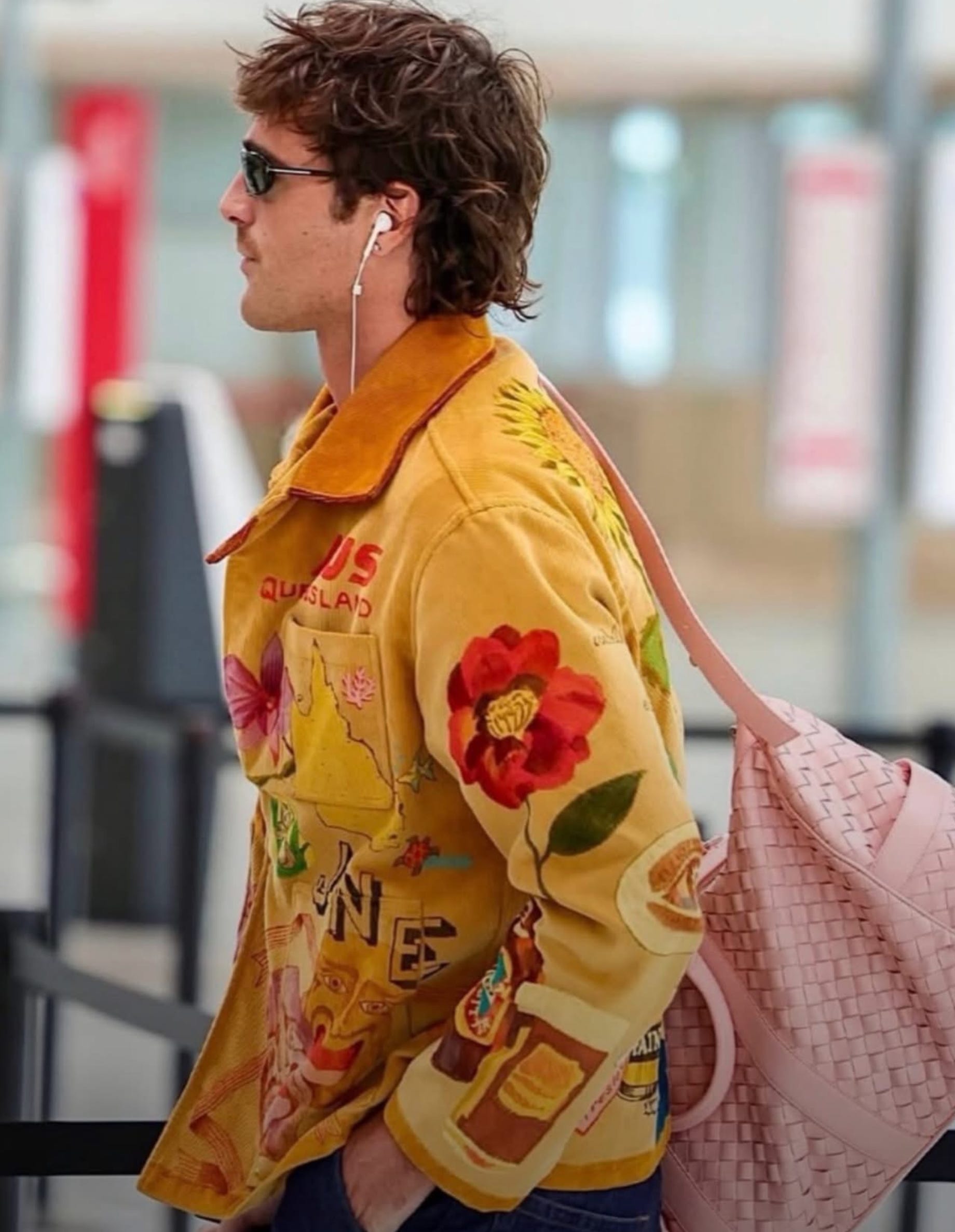
No tag needed.
Handbags are social objects. Jewellery is often intimate and far more personal.
Fashion media also played its main character part. Entire editorial spreads have been dedicated to ‘the bag of the season’, ‘the investment tote’, or ‘the handbag you need now’. It’s much easier to build a cultural moment around a bag (look at The Olsens) than a pair of gold earrings quietly doing their job for the next forty years.
Then of course there’s our beloved social media. A handbag is legible from ten metres away. A necklace requires a little more attention. In the era of the quick scroll, the handbag wins. Hello again little pistachio Mini Kelly.
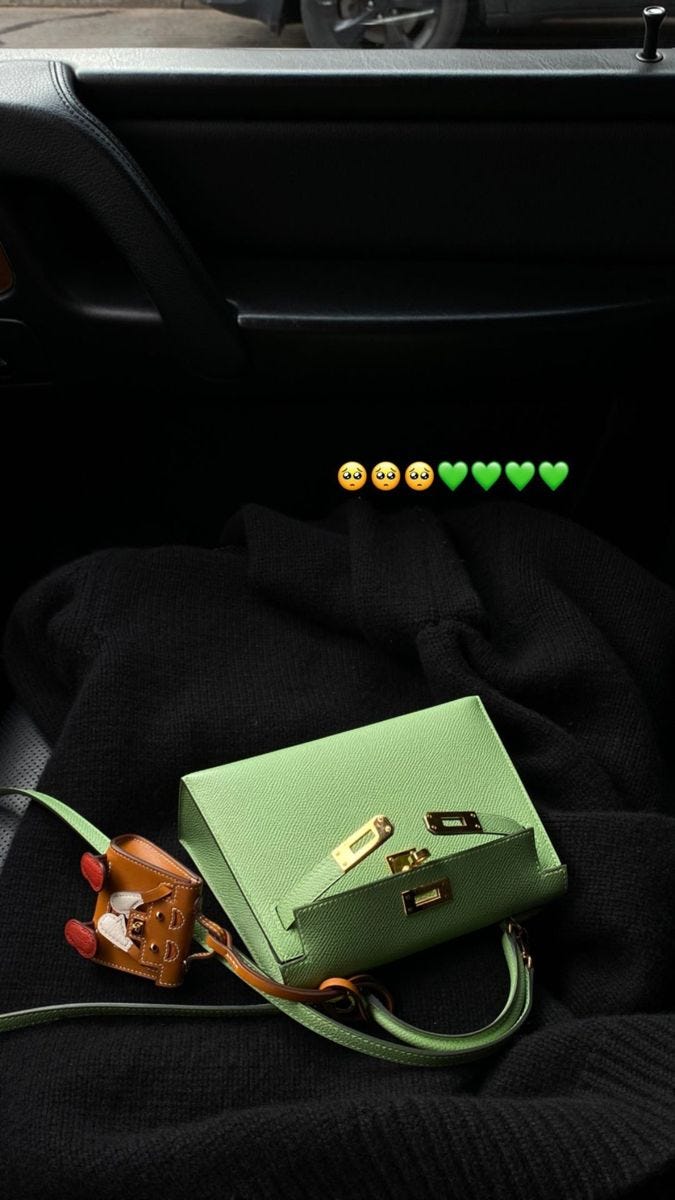
One of many, many, many Hermès bag instagram posts.
And let’s be honest - handbags are also very good at announcing themselves. They sit proudly on the arm, logo facing outward, letting everyone know exactly where they came from. Jewellery is the underdog. It doesn’t scream its credentials quite so loudly.
In many ways, jewellery simply became quieter while handbags became louder.
And in a culture that rewards visibility, the loudest object in the room often gets mistaken for the most valuable.
From September 2025 - gold really is having its time in the sun once again.
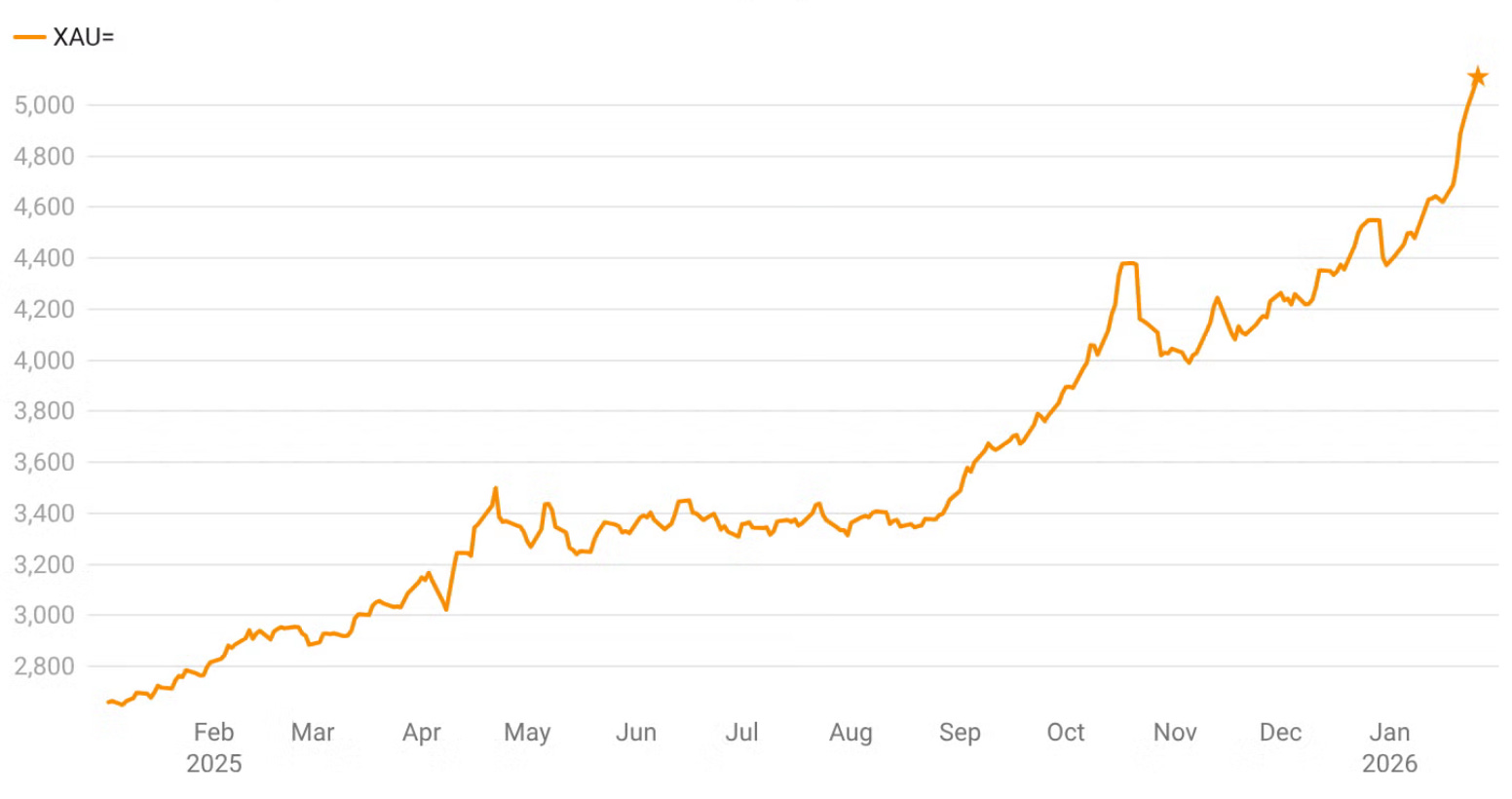
In recent years the price of gold has risen sharply, largely driven by the kind of global uncertainty that tends to make people nervous about traditional markets. Inflation creeps up, currencies wobble, geopolitical tensions simmer - and suddenly the oldest asset class in the world starts looking rather sensible again.
Central banks have also been quietly buying gold at record levels. Which is interesting, because central banks aren’t known for following fashion trends. When institutions responsible for entire national economies start accumulating gold, it tends to signal something deeper than a passing moment.
Historically, gold has always acted as a kind of financial anchor. When paper currencies fluctuate and markets become volatile, investors often move toward assets that feel tangible and finite. Gold doesn’t rely on a brand narrative, a quarterly earnings report, or a social media following. It simply exists - scarce, durable and universally recognised.
When economies wobble, people tend to return to things that are real.
And gold has always been one of the realest things there is.
After all this talk of value, markets, handbags and gold, a few practical thoughts if you’re thinking about buying - or selling - the good (yellow) stuff.
Not all gold is created equal. And before you dash to sell Granny’s gold.
Just a few (hopefully helpful) thoughts below.
9k, 14k, 18k and 22k all contain different percentages of gold. If you’re selling pieces, make sure they’re weighed properly and priced against the current gold price. A reputable dealer will always do this transparently. I suggest RPM in Hatton Garden. You can also check value before you go online (you just need to pull those kitchen scales out). The days of cash 4 gold are over - and actually, thinking of sending a bunch of gold in a bag is WILD to me.
Timing helps.
Gold prices fluctuate daily, and when the world feels a little uncertain, inflation rising, currencies wobbling, markets jittery, gold climbs. If you’re selling, it’s worth keeping a casual eye on the price rather than rushing into it.
Sentiment before scrap.
Before selling anything, pause. Once gold jewellery is melted down, the story disappears with it. Granny’s earrings might technically be worth their weight but sometimes the memory they carry is worth more. Try to avoid ‘gold fever’ if you can.
Buy pieces you’ll actually want to wear, everyday.
Saving for ‘best’ is a waste - in my opinion anyways. If you’re investing in jewellery, choose pieces that will live with you. A well-made gold necklace or ring can be worn every day, quietly becoming part of your life over time. At RF we’ve always been about our customers and we have several custom options (without the wild markup) that help you celebrate you, and mark those major moments. Shameless marketing plug here, but I believe in what we do - and the bespoke pieces are great.
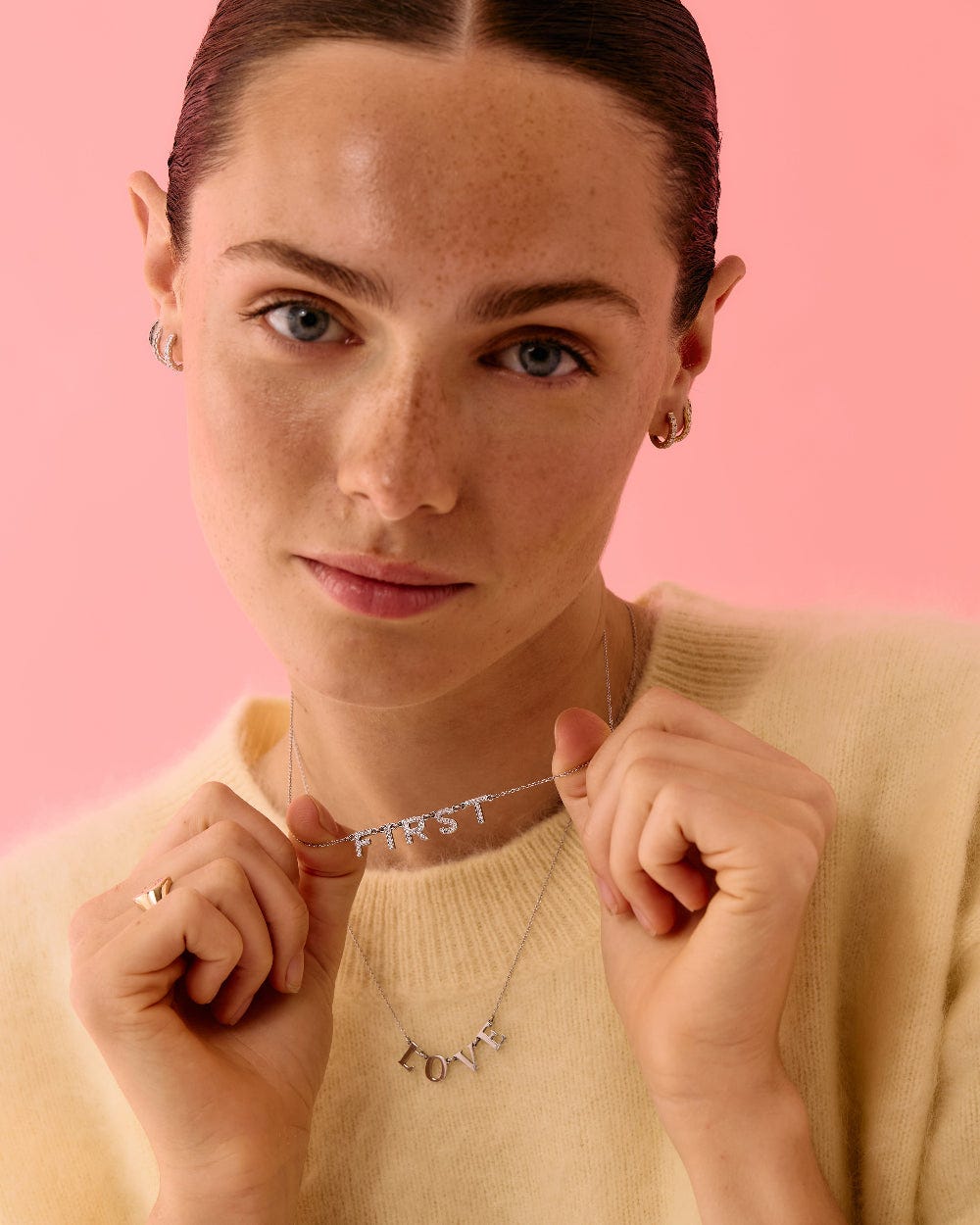
RF Custom Diamond Letter Necklace.
Choose craft over hype.
Trends come and go, logos get louder and quieter, but good materials and thoughtful design tend to last forevs. Gold doesn’t need to shout. Explore brands off the beaten track, independents - you’ll most probably get a better service (minus the Bond St snobbery) and it will mean so much more. Plus - your collection won’t be the same as everyone else’s. Jewellery should be about you.
Remake rather than sell.
One of the beautiful things about gold is that it can be melted and reused. Old jewellery can become something entirely new, a bespoke ring, bangle, anklet while the original gold remains. The material stays, the story simply evolves. I have a great ‘guy’ that does all bespoke, at excellent prices (without the Hatton Garden schlep or the dodgy vibes). Speak to a top drawer chap, goes by the name Will at Future Production group (william@future-production.co.uk). You are welcome.
Consider vintage.
Vintage jewellery is often one of the most interesting ways to invest in gold. You’ll find unique designs, beautiful craftsmanship and pieces that already carry a history. And in a world where so much feels temporary, there’s something rather wonderful about wearing something that has already lived a life before you found it (or perhaps slightly creepy - depending on how you choose to frame it in your mind).
It’s not for me personally - I’m not an Albert chain girl - but if you love those Victorian-esque styles, then you’d better get searching. I’d suggest buying the real deal, not a heavily marked-up modern version pretending to be vintage (the original is always better). I’ve been told there is a great jewellery market in Covent Garden from 5am at The Jubilee Market Hall. Never been though, so please double check this. Sotheby’s have some top tips here. Oh and first Dibs, obvy.
Jewellery occupies a rather unusual space. It is one of the few objects that can be both emotional and financial at the same time.
A gold necklace or ring is, of course, beautiful. It is worn, loved, and often associated with moments in life - birthdays, anniversaries, engagements, a new job, milestones. But beneath that sentiment sits something more tangible: material value. Gold has weight. Stones have worth. Craftsmanship has permanence.
Very few things we buy manage to hold both of these qualities at once.
Fashion pieces tend to live in the moment. Technology becomes obsolete almost immediately. Cars lose value the moment they leave the showroom. Jewellery, however, exists in a different category altogether. It can be worn every day, passed down through generations, and still retain value long after the original purchase.
So next time you’re thinking about a Chanel bag or Bottega Veneta bag for £5k+++ (if that’s a thing for you) - is it really worth it?
Perhaps that’s what makes jewellery so unique. It doesn’t just mark moments in life - it carries them forward.
And in doing so, it becomes something rare: an object that holds both memory and material worth at the same time.
Maybe that’s the real definition of an investment.
And those are usually the things worth holding onto.
Anon,
Rocky x